

I want to start off by being sure you see this link to download my free Passover stuff:
Click here to get the Passover checklists and Haggadah I use for my Seder I will describe below.
Over the years, many have asked me how I observe Passover in my home home. Please search the scriptures yourself and run your ideas and questions by your husbands if you’re married. But if you just want to read how I do Passover, then read on, and I hope it’s helpful! Also, please know I wrote this before my recent marriage to my husband, Todd.
The Biblical Commands
First, let’s review the Biblical commands for doing the Passover meal. Yahweh has given us very few commands regarding Passover, and they are not at all difficult. See Exodus 12, 34, Leviticus 23, Numbers 9, 28, 33, Deuteronomy 16, Joshua 5, 2 Kings 22, 23, 2 Chronicles 35, 2 Chronicles 30, Ezra 6, Matthew 26, Luke 22, 1 Corinthians 5, 11. Here’s a very quick recap of the Biblical commands that we can do today for Passover:
- It’s only for those in covenant with Yahweh.
- Remove leaven from the home first.
- Eat the Passover meal on the 14th day at twilight. (Some call this the beginning of the 15th day. It’s at sunset.)
- Eat only unleavened bread at the meal.
- It is to teach the children.
- Tell the story of the Exodus.
- Eat bitter herbs.
- Drink wine (or grape juice).
- Remember the redemption and salvation given to us by Yeshua’s death with the bread and the wine.
I truly don’t have time to go into the theology of why I do or believe how to do things at Passover. Many have written very thoughtful posts on these subjects. I’m going to try to keep this article strictly practical, focusing on how I do these things.
Now, I’m going to start explaining item by item. Please remember that I do all of the Biblical commands listed above. But I also do a lot of other things in my Passover that are not commanded. All you need to do is the Biblical commands. Beyond those, you have freedom to do whatever you want for Passover as long as it doesn’t break some other Torah command. So be creative and invent your own traditions! Most of what I’m going to talk about is just tradition, because the Biblical commands are so few and simple.
I made my own Haggadah. A Haggadah is the booklet that contains all the Passover Seder readings. It’s like a program. I started with one someone else made, then changed several parts to make it how I wanted. I removed some parts and added some parts. You can do this, too! You have a lot of freedom with your Seder! I’ll explain more about my seder later in this article. You can download my Haggadah for free in the Passover Kit at Store.TorahSisters.com. And it’s editable so you can change the words, names and anything you want.
To obey the first command, that the Passover is only to be eaten by those in covenant with Yahweh, I simply only invite Believers to my home for Passover. Passover is to me, now, much like what Communion was when I was in the mainstream church. (Honestly, Paul was talking about Passover in those “communion passages.) Paul and Torah remind us that if our heart is not right with the Father and we are not in covenant with Him, that we will die if we partake in the bread and cup. So, I only invite those who are in covenant so far as I know. At a certain point, I remind my guests to skip the bread and wine if they have heart issues they need to address.
One thing we do about two weeks before Passover is we put up a red cloth over our doorway to remind us of the first Passover and the blood of Yeshua.
I prefer to do Passover in my home. I like the intimacy, and I see a pattern for doing it in the home in Scripture. But Yeshua rented a room, so you can, too, if you want. But doing Passover in my small home means I can only invite a couple of families each year. I imagine some of you have the same dilemma: you want more people to come, but some want to be invited year after year, and you just can’t fit them all. My friend Anne Elliott has a solution for this, to try to keep it fair, and I’ve adopted her solution as well, so this is what I tell my guests each Passover: “I’m so glad to welcome you to partake in this Passover meal with my family and me. I want you to see how I do it tonight, ask questions, and learn as much as you can. But next year, I won’t invite you back. Rather, I want you to have your own Passover in your home with your own personal family. The next year, invite others to your home to see, partake, and learn like you are this year. That way, I can keep inviting other new people, and so can you, and together, we can keep reaching more Believers and show them how to do Passover, like a ripple effect.”
I say a lot more than that, but that’s the gist of it. Many people get really nervous about doing it, but they often just need encouragement. So, to make it simple, here’s my recommendation: Do your first Passover with just your immediate family. Do your next with others you’ve invited to your home, and so on and so on.
Get the Matazh
Plan where you’ll get your matzah, or plan to make your own. I ordered it on Amazon. But order early, because it can take a while to arrive. Some grocery stores carry it, too. I order about three or four pieces per person, but when I have lots of kids coming, I order lots extra. The Seder is long, and they get hungry, so I let them munch on it during the whole Seder. Any leftovers will get eaten during the rest of the Feast. You’ll also find many recipes in these magazines.
Spring Cleaning & Removing Leaven
Next, I’ll mention that in the days leading up to Passover, I deep clean my home. The purpose is to remove all the leaven. There are various interpretations of what exactly leaven is. I, myself, have changed my mind on this issue over the years. But whether you think leaven is your sourdough starter and all your risen bread, or also any product with yeast in it, follow your conviction and remove those items from your home before sunset on the night of the Passover meal.
The other perk of this whole process of cleaning is that my home is sparkly clean as I’m preparing to have guests over and celebrate not only the Passover meal, but the entire week-long feast! As my kids and I clean, we talk about how Paul tells us that leaven reminds us of sin, and we need to spend these preparation days searching out the sin in our own hearts before we come to our Lord’s table at the Passover meal. Of course, any discussion of sin leads to a discussion of the Gospel of grace and Yeshua’s sacrifice that enables us to be in covenant with Yahweh despite our sin that we can never fully get rid of, just as we can never fully get rid of the leaven in our home. The toaster is a great Gospel discussion starter this time of year!
And yes, removing leaven means that I throw out a lot of food. Oh, well. It’s a small price to pay in obedience out of love. He’s bigger than my grocery bill, so I don’t worry about it. Adios, leaven! See you in a week, bread! Don’t forget to check the freezer for leaven. Been there, forgotten that! Again, a great Gospel illustration!
So, by Passover, my home is clean, and the leaven is out. Except I do hide one piece of plain bread for the kids to find at the beginning of the seder. (The word seder means an order of events, like a program.) I wrap the bread in a napkin, on a paper plate, or something so bread crumbs don’t mess up my leaven-free, clean home, though!
A Plush Lamb
We also get a white stuffed animal lamb to keep front and center in our home starting on the tenth day. We use it to remember what it was like for the Israelites to keep the lamb in their home, love it, and then sacrifice it. Do you see Yeshua in all of this? Isn’t it beautiful? Click here to see the plush lamb I just ordered.
On the 14th
We eat the Passover meal on the 14th day at dusk. Some people call this the beginning of the 15th day. I follow the sighted moon, so I don’t know until fourteen days prior if the meal will be on this day or the next. So, when I invite people, I say, “Will you please come to Passover at my home on April 1 (or whatever day it is)? There is a possibility it will be on April 2, instead, but I’ll let you know for sure a couple of weeks ahead.”
Make it About the Kids
One of Yahweh’s main purposes in asking us to do Passover each year is to teach the children, so I make a big deal of it for the kids. I hope that when I’m an old lady, I’ll still have my grandchildren here and invite other young families. I can work to impress adults at the other Feasts, but this meal is for the kids. They are the focus. Surf around and do it a bit differently each year. Last year, I taught the kids like I used to teach Sunday School classes. I used my “teaching kids voice,” asked questions, and did the whole bit. Break out the flannelgraph, use object lessons, watch a short video, have the kids act out the Exodus story, use props-whatever! You can even have the small children come sit near you on the floor. Somehow, spend at least part of your Seder program talking just to the kids. Your adult guests will know and appreciate that’s what you’re doing. Parents will love it. I thought I’d be nervous, so I actually made notecards, which was fine! You don’t have to be an expert or a great teacher. You’ll be following Yahweh’s commands. Don’t you think He’ll give you the words to say and make it work out just fine for His glory? Click here to see some fun props on Amazon for telling the story.
The Food!
Now, let’s talk about the menu. Some people believe you must eat lamb and some think you are not permitted to eat lamb. I don’t think it’s required because there’s no temple to sacrifice it at, which is a good reminder that we are just sort of observing and practicing the Passover and can’t quite do it perfectly, especially since we aren’t even going to Jerusalem! I do hope I can do the Feasts in Jerusalem soon!
The only requirements for your menu are that your food be Biblically clean (Leviticus 11) and that it not contain leaven. Beyond that, you have loads of options. I’m not very good in the kitchen, so I’m not going to spend much time talking about food here because many other bloggers are much better cooks than I am! But I do have some tips.
One thing to consider when choosing your menu is that the food has to stay warm while you are doing the talking and program part of your Seder. I don’t serve the food for a good hour or two into the seder. I borrow roasters and such to keep the food warm so I can be done cooking by sundown and then I can fully participate in the Seder. Choose food that won’t wilt while it waits. I prefer to make all the food myself, so I know it’s Biblically clean and doesn’t have leaven.
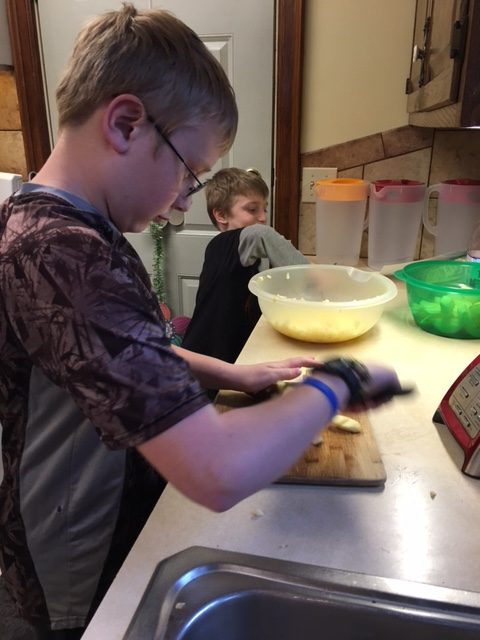
We make charoset the day before. It is a traditional food, and you can read more about it in the Haggadah. There are several recipes online. Some make it with wine, some with grape juice. I recommend making it very sweet.
I actually bought some of my food pre-made. Think Gordon Food Service, or buying from a catering company, etc. I serve some meat, a couple of side dishes, and a dessert.
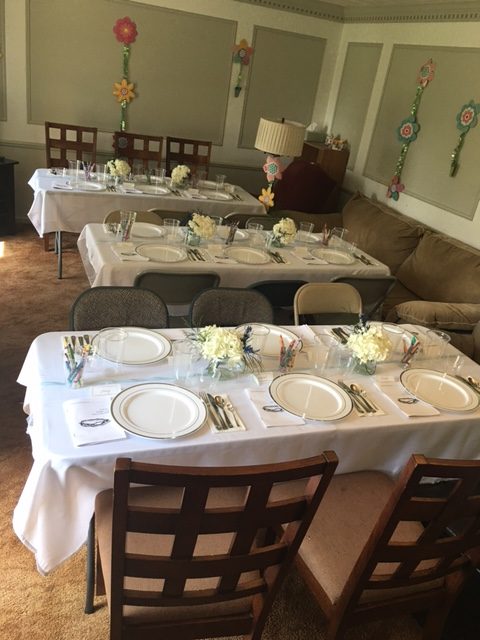
I couldn’t fit all my guests and tables in my dining room, so I moved furniture around in the living room, and we had our Passover there. I had to set up three or four of the six-foot folding tables, which meant serving the food buffet-style from the kitchen counter. I prefer to serve family-style, but it works out just fine.
Decorate!
I decorate my home with spring-like decorations, most of which I bought at the dollar store or Amazon. I plan to buy a little more each year to use over and over again. But it’s okay to do a paper plate Passover! You and your guests should be focusing on Yeshua, not the tableware.
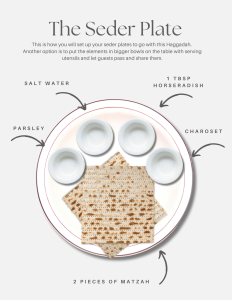
Also, Amazon has small plastic appetizer bowls that are perfect for the Seder plate, each for a different part of the Seder. Look at the section where they sell the wedding stuff. I did buy the biggest plastic charger plates they had for the Seder and put the little bowls on them. I had separate paper plates for the meal.
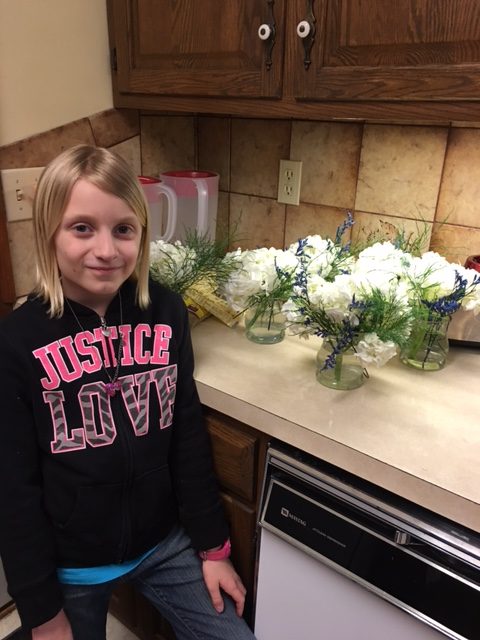
My daughter arranged the flower centerpieces.
I bought flowers for centerpieces, but I cut the stems short because I didn’t want tall centerpieces, so people couldn’t see one another. I bought clear plastic napkin holders at the dollar store to hold lots of extra matzah for the kids to munch whenever they wanted. I put out two per table to share. I set out all the Seder supplies before guests arrived.
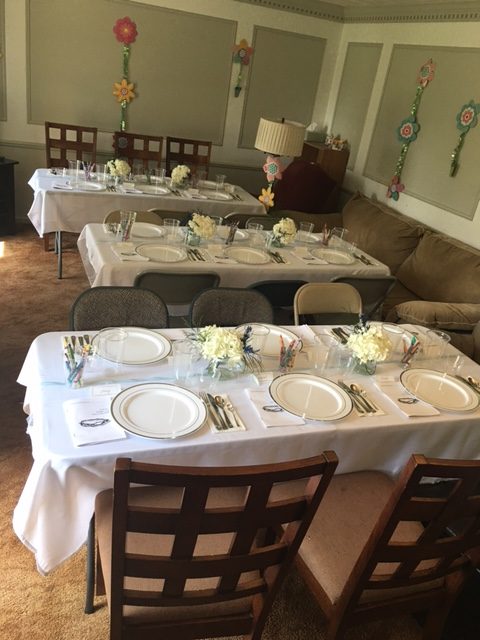
Everything on my tables was white, clear, or silver, except for a little light blue. The fanciest and thickest paper plates I could find, both the dinner plates and the matching dessert plates, had a little bit of light blue in the design. So I got some white and light blue ribbon to tie around the flower vases and a few other places for just a splash of color. Keeping everything else white and silver made it very elegant on my budget. Think wedding-style, and then decorate however you want with any colors you choose.
Here’s the bottom line. I make the Passover as fancy as I can within my budget. I want my kids to know this is a special day, and we bring out the best to honor Yeshua for this special date with the Father. I also asked my guests to dress up a bit. When the little girls walked into the room, they gasped and said, “It looks like a wedding!” I hadn’t realized it before, but they are exactly right. Passover is preparing for the Wedding Feast of the Lamb.
I made name cards and placed them where I wanted people to sit. There was a definite seating strategy. But the kids thought the name cards made it fancy, too. I actually let the big kids all sit together at their own table. They had so much fun, but were good listeners when it was time to listen!
I did as much as I could ahead of time. I think we even set the table the day before! That may be overkill, but I’m not much of a domestic diva, so anything that makes my life easier is great.
Busy Books for the Kids
I recommend busy books for the small children. The entire evening lasts about 3-4 hours, so they do get antsy. Bible Pathway Adventures has generously given us a busy book for the preschool kids. It’s in my Passover Kit download. They have more Passover activities for bigger kids, too, at BiblePathwayAdventures.com.
Fun Kid Traditions
Some people ask the children to wear their coats and hold a stick during part of the Seder to remember the night of the Exodus. They will never forget it, that’s for sure, and if it helps them remember the Exodus and that we are just sojourners in this world with a heavenly citizenship, ready for Yeshua to return. Some also have pillows to recline as Yeshua reclined, and because we can rest in Him.
This may also be a good place to mention another tradition we have: staying up all night. I usually don’t survine it, but my kids do! I rent the Joseph Prince of Egypt movie, so they watch that a couple of times, play games, and just hang out. Many families do this to remember that first Exodus night of watching and waiting for Yahweh. Plus, it’s fun.
This part isn’t in the Haggadah, but on the day of Passover, I hide a piece of bread wrapped in a napkin somewhere in the house and tell my kids to find it before our guests arrive. The finder gets a prize, and we throw the bread outside. Other families do this a bit differently. It’s a fun tradition.
About the Seder and Haggadah
Look at the top of this article for the link to download the Haggadah in the Passover Kit. I tried to add lots of cues so the leader knows what to do and when. Most of it is self-explanatory, intentionally so. Usually, the man of the house is the leader. There are three parts for the smallest children. And there are several reading parts of Scripture for older kids or any guest. We just go around the room as we go through the Seder. We also ad lib a lot! Sometimes it’s hard to stick to a script. If you think something needs more explanation, take a moment to explain or teach, especially if someone has a question. The Seder is a little formal, but not so formal that you can’t follow the Holy Spirit’s guidance!
We do footwashing at our seder, following Yeshua’s example. I let my guests know this in advance. Of course, if someone doesn’t want to participate in this (or any part of it), I don’t make them. It’s written in my Haggadah, and I have basins, bowls, and towels ready. We will fill them half full with warm water when it’s time. I have one bowl or basin and one towel for every two to four people, so it doesn’t take too long. I ask the head of each family to wash those “under” them. I turn on the music, and even though there is loads of laughter and awkwardness, my guests have told me it was deep and meaningful to them.
Take your time during your seder, and it will take time! This Haggadah can last 3-4 hours! Start at sundown. Warn your guests that it will be a late evening. Let the children munch on matzah whenever they want, since it’s a long time until dinner is actually served. You may also want to have a better snack on hand for hungry littles.
There will be lots of laughter and lulls (and bathroom runs) in between different parts of the Seder. I suppose some people have very formal and stiff seders, but not me. We laugh, have fun, and celebrate! The things we do are unusual, so people giggle, and it takes them time to participate at certain points. That’s okay! Let them take their time, have fun, talk, and chat. We even turn on music during those breaks. Find a fun Passover playlist on YouTube and crank it! Stopping the music also works as a good cue to quiet everyone down when it is time to begin again. Use those breaks to refill the wine/juice, drinking water, and matzah if needed. We also used it to clean up spills.
When the guests arrived, I had a large seder plate already set up at each setting. I used the largest charger plate I could find. I don’t use traditional seder plates, but you can. Each plate had two matzah and four little bowls or cups. One with parsley, one with salt water, one with horseradish sauce/spread, and one with charoset. This all made the tables very pretty. I also get dollar store napkin holders to put extra matzah on the tables for snacking. Some people just put these items in the middle of the table and share them family style, which works great, too!
I’ll just quickly add that I skip the egg because the origins of that tradition are “iffy.” Just Google it. I skip the Elijah cup and setting because the one like Elijah already came in John the Baptist. How blessed we are to see such things fulfilled!
A Side Table
Another time-saver I learned last year was to set up a small side table to hold the extras. No one sat at this table, but I used it to keep some of the things we would need throughout the Seder within reach, so no one has to run to the kitchen. It held extra pitchers of ice water, extra pitchers of grape juice, the wine, loads of extra napkins, extra boxes of matzah, a big bowl of charoset, the gift for the afikomen finder, flowers, and a framed sign about Passover. It was truly very utilitarian and came in very handy!
I bought extra pitchers so I’d have lots of sparkling grape juice and ice water ready. Have helpers to refill cups at the right times. The leader can keep reading while they work to save time.
Eating and Singing
When it was time to eat, I asked helpers to bring all the seder plates to the kitchen. Or, maybe the 4 bowls/cups at least. There are a lot of dishes, so have a basin ready to store them all so your counter doesn’t get too cluttered. You can even stash that basin of the used seder bowls in the laundry room or somewhere until it’s time to really clean up. Several guests wanted to keep the matzah they hadn’t used yet. Then we served food buffet-style, and they each got a new plate to eat from. We took our time eating, even allowing for seconds. Then we finished the Seder. It was getting late, so we skipped the singing and had cheesecake. If you do choose to sing, be prepared with song sheets, music, or whatever you want. I may break out the ‘ole hymnal next year and play piano and have an old-fashioned hymn sing until midnight. It will be late by that point! We start at 8:00ish, after all.
Final Tips
Have fun! Celebrate!
Be sure people can hear the leader. He/she should stand, I think, so they can be heard better.
Remember you’re talking to kids. My Haggadah is very simple, and I ad-libbed to make it even simpler at times so the kids could truly understand and remember. It’s for them.
Don’t rush. Warn your guests that it may go to 11, midnight, or even later! Then relax.
Let your guests have freedom. Because it is so long, let them put their smallest children to bed in your bedrooms, etc. Be flexible. Let them all stay up all night with you, even!
Be ready for spills. A wise friend told me to have some stain spray, rags, and paper towels on hand for grape juice and wine spills. We used it! And all the stains came out. No worries.
Write notes on your Haggadah to save for next year. Before you forget, as you think of things, write them in the margins of your Haggadah and save it so you have the notes for next year. If you’re like me, every Passover will be your “best one yet!”
Next year in Jerusalem!
This article was so long! So I’ll end it by saying I hope this has helped, and you have a blessed Passover. Next year in Jerusalem!
Shalom and Chag Sameach Pesach!,
-Amy Kay Hickerson
Please send me a copy of haggadah(PDF)
Click here to get it.
Hi Amy,
I’ve been a Passover keeper for many years now. I think maybe 30-something now. I found your magazine recently and just love your ideas. I’m curious if you choose to incorporate a foot washing ceremony. It’s something that has always been a part of mine from back before I started my own family. And I find that it reinforces to my children how important it is that we serve one another. I didn’t see a mention in your article so I thought I’d ask. Thanks for all your effort to share the Good News.
Love in Messiah,
Ami
Never mind. I just read again and saw where I missed it. Oops.
Shalom. Ami
Yes! It is in my article, about half way through.
Thanks for writing this post!! We are so excited to celebrate Passover this year and your article is most helpful. Thanks again!
Yay! It’s is SO exciting! I’m doing my fifth this year, and every year I say, “This is the best one yet!” You’re SO very welcome!
This is awesome. Would love to have this available to download as it would be great to share when sending a link won’t do. 😉
Thanks for all of this!!!
Blessings!
So glad I found this website! I did have a question, just about your opinion. You said you only invite people in Covenant, so would you include Christians that don’t keep the Feasts yet? My family isn’t there yet, but I think the more they see the beauty in the Feasts and the more we include them, the sooner they’ll come on board. Thank you!
Yes! Invite them!
Hello! The Passover is a renewal of the vowed you made when you got Baptized in Christ and with laying hands upon your head asking God by prayers to ask to receive his Holy Spirit! Only People that are truly baptized that observe the Passover. The Passover is not suppose to be like a party that you invite just about any jo blow around. One thing is they surely will not understand the depth of the whole thing.
The Passover is not a meal that your taking with friends….Its about of all our brothers and sisters in Christ.
Hope that I did not offended
I love this post! I’ve had it saved in my email and pulled it out again this year in preparing for Passover. I’ve never even thought about foot washing at Passover even though Yeshua did it with His disciples right before His crucifixion! What a great idea to add it to the Passover celebration.
Thanks for all of this great info!